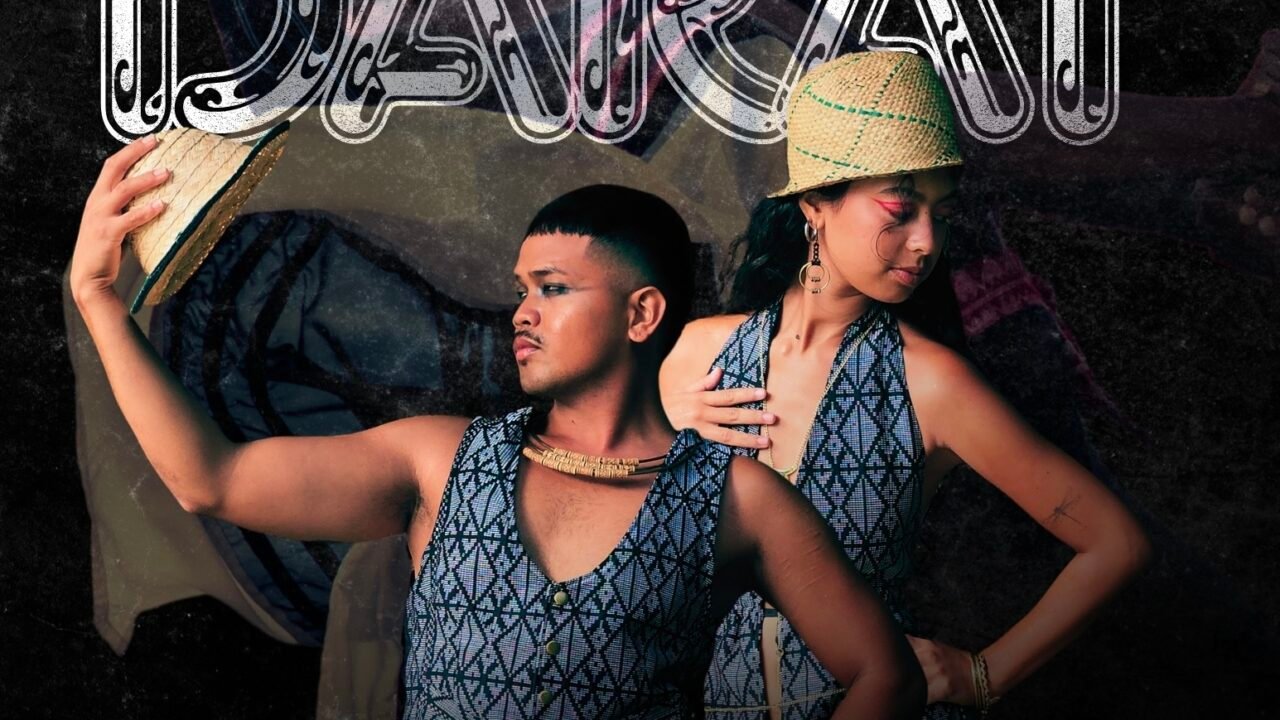
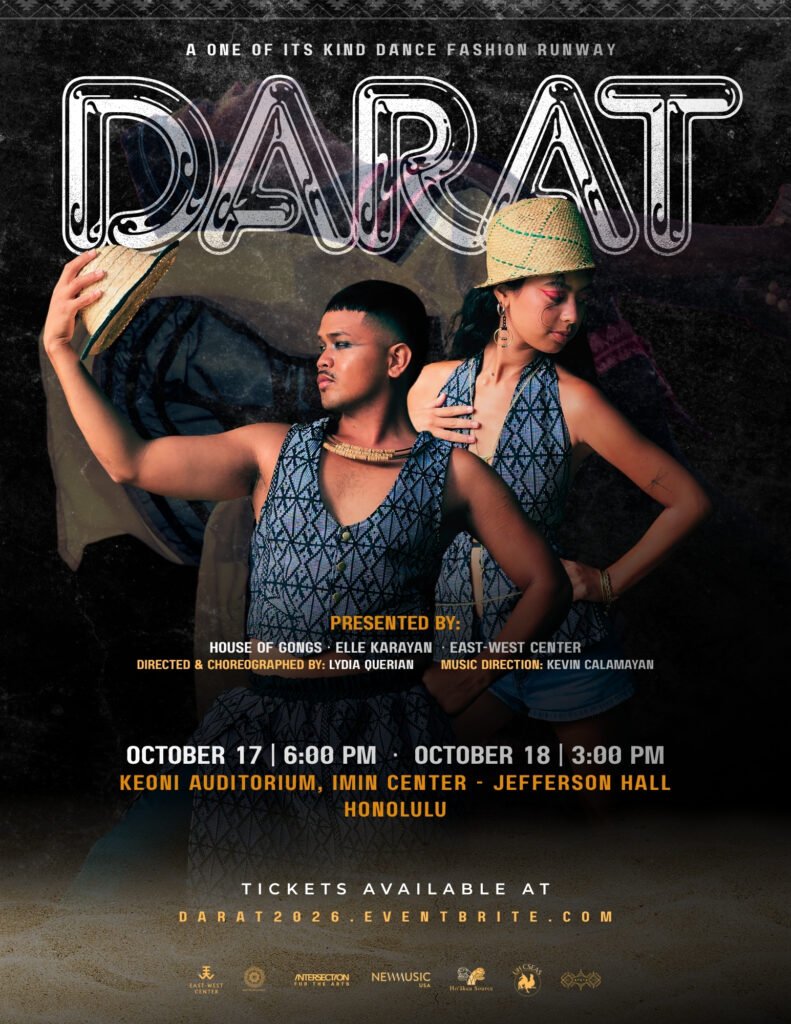
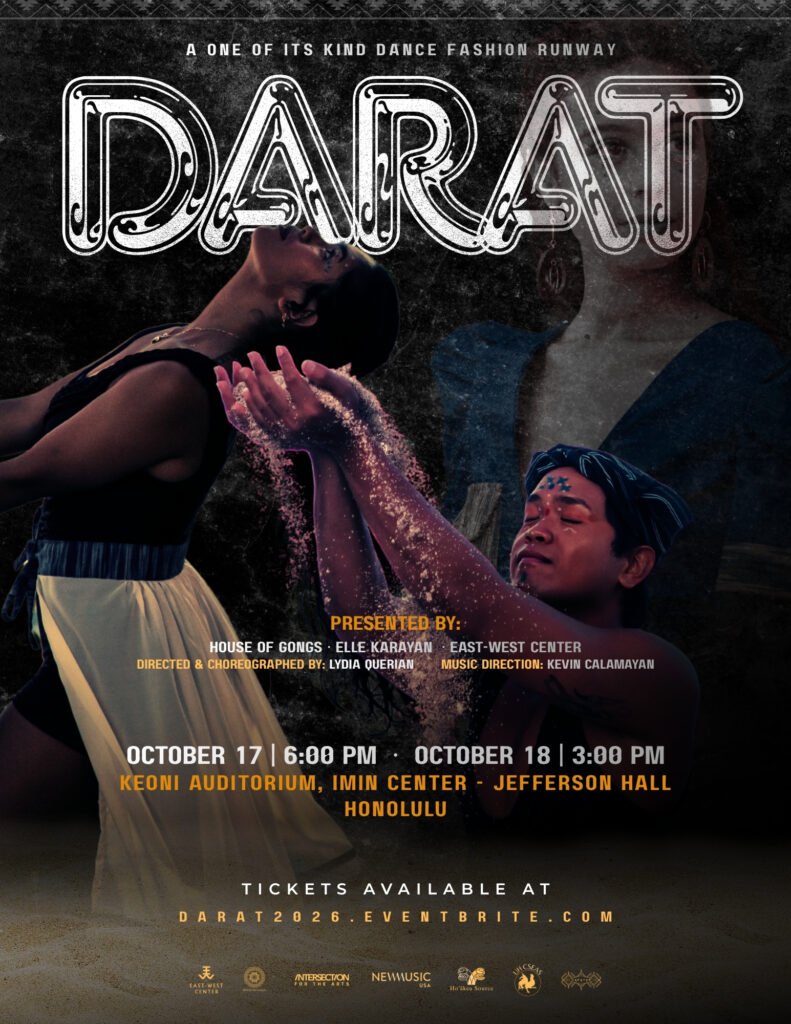
DARAT: An Immersive Dance Runway in Five Movements will bring together contemporary dance, fashion, live music and cultural storytelling at the East-West Center on Oct. 17 and 18, in observance of Filipino American History Month.
Presented by House of Gongs and the East-West Center, the production was conceived, directed and choreographed by interdisciplinary artist Lydia Querian. It commemorates the 120th anniversary of the arrival of the first Filipino plantation workers, known as Sakadas, in Hawaiʻi.
The performances are scheduled for 6 p.m. Saturday, Oct. 17, and 3 p.m. Sunday, Oct. 18, at Keoni Auditorium in the Imin International Conference Center at Jefferson Hall. Tickets are available through the production’s Eventbrite page.
What ‘DARAT’ means
Darat is described by the production as an Ilocano word associated with flowing sand or land. The show uses that idea as a starting point for an artistic reflection on ancestry, migration, labor, land and belonging in the Filipino diaspora.
Rather than using a conventional fashion runway, the production will stage its four fashion collections within a performance space that incorporates dance, music and visual elements. Organizers describe the format as a five-part narrative moving through elemental themes before concluding with a collective act of reclamation.
Querian, who traces her family history to Sakada laborers, said the work is both a tribute to her ancestors and an exploration of a shared future.
“Historical and present colonial systems attempted to fragment us, but DARAT reminds us that we come from the same core elements,” Querian said in a statement.
Sakadas and Filipino history
The term Sakadas refers to Filipino laborers recruited to work in Hawaiʻi’s sugar plantations in the early 20th century. Their arrival in 1906 marked the beginning of a major wave of Filipino migration to Hawaiʻi, shaping families, communities, labor history and cultural life across the islands.
DARAT uses this history not simply as a historical backdrop, according to the production team, but as a lens for considering the ongoing relationships among migration, work, family memory, cultural identity and place.
The performance also aims to acknowledge Hawaiʻi as a place with its own Indigenous history and living Native Hawaiian communities. Organizers said the work was developed through movement workshops, archival research and story-sharing circles intended to strengthen accountability to local and host communities.
Music, movement and fashion
The production’s soundscape will be led by music director Kevin Calamayan and will incorporate kulintang, percussion, wind instruments, vocals and Indigenous rock influences.
Kulintang is an ensemble tradition centered on a row of small, horizontally arranged gongs. It is practiced in parts of Mindanao and the Sulu Archipelago in the southern Philippines, as well as in neighboring areas of maritime Southeast Asia. In DARAT, organizers say the musical elements will be presented alongside contemporary performance forms.
The cast includes dancers, fashion models, musicians and cultural practitioners, with a largely Filipino diasporic ensemble. The performance will also feature four collections from Querian’s fashion label, Elle Karayan.
Special guests and collaborators include cultural commentator Jon Luigi, researcher Adam Keawe, Jae Tioseco and Sama culture bearer Al-Raffy Harun, according to the production team.
About the production
House of Gongs is a Filipinx-led cultural organization that presents educational programs, performances and intergenerational arts initiatives centered on Filipino musical traditions and contemporary creative practice. Its work includes festivals and community programs in Oʻahu and the San Francisco Bay Area.
DARAT is produced by House of Gongs and presented by the East-West Center, with support from New Music USA and Ho‘akea Source. The production is led by Querian, with Ron Querian as executive producer and Dianne Deauna and TJ Aranas as administrative producers.