U.S. Rep. Grace Meng joined Filipino American, Nepali American and other immigrant-community leaders Saturday night at a Queens benefit concert for survivors of Nepal’s devastating August floods, which killed more than 1,400 people and left thousands missing.
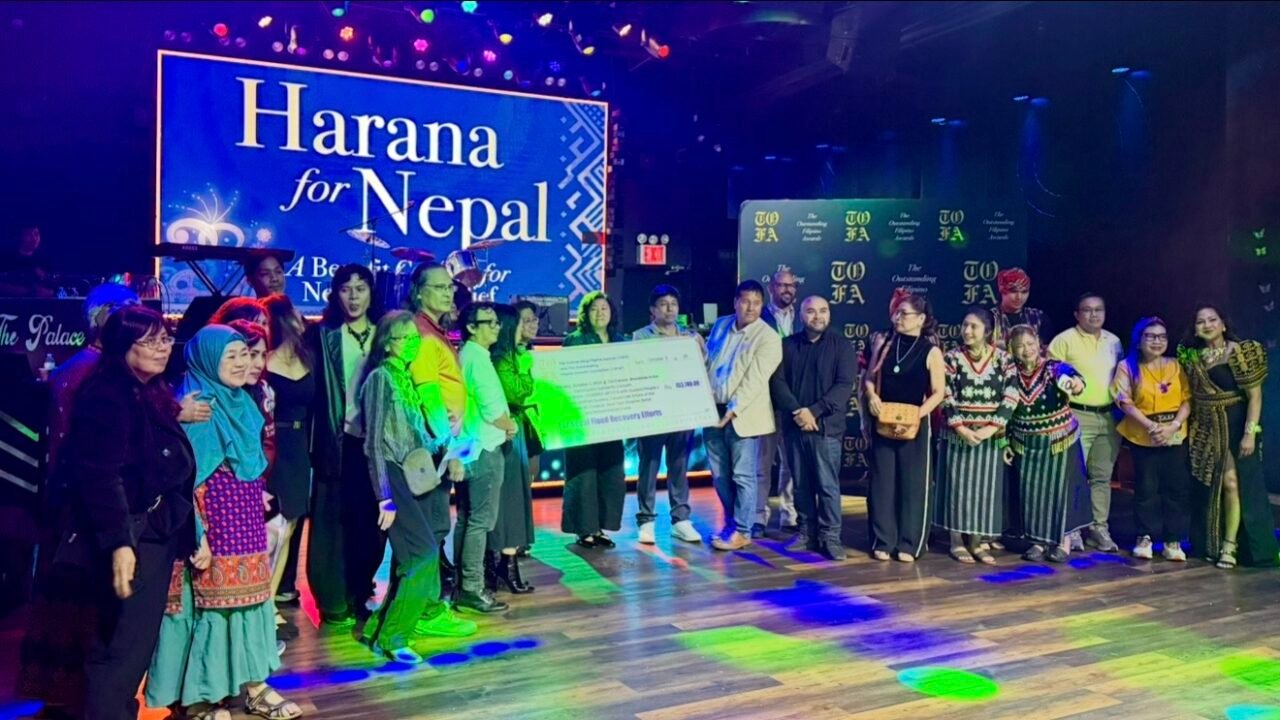
The event, “Harana for Nepal,” brought performers, organizers and local officials to The Palace Queens in Woodside for a program of music, speeches and fundraising. Organizers presented a ceremonial $1,000 check, in Nepali rupees, to Pasang Sherpa, president of the Rotary Club of New York Queens, for flood-relief efforts in Nepal.

Meng also presented Sherpa with a ceremonial check representing more than $36 million in U.S. humanitarian assistance for Nepal and Tibet. The federal aid package followed congressional pressure from Meng and others after the initial U.S. response consisted of one disaster-response adviser and $500,000 in emergency assistance.
“The assistance remains far below what affected communities need,” Meng said in a Sept. 23 statement, “but it is a significant improvement over the administration’s original response.” She said she would continue to stand with Nepali and Tibetan communities in Queens as families search for missing relatives and begin rebuilding.
The concert was organized by Queens People’s Movement; the New York Disaster Relief Rehabilitation Fund; United Federation of Fil-Am Educators, Queens chapter; the Concerned Artists of the Philippines, New York chapter; and The Outstanding Filipino Awards. The program ran from 7 to 11 p.m.
The title carried particular resonance for the Filipino American-led gathering. A harana is a traditional Filipino serenade, and organizers used the form as an expression of solidarity — pairing music with an appeal to help Nepali families displaced by the disaster.
The flooding followed an Aug. 26 glacial collapse that triggered destructive flash floods and landslides through Nepal’s Bhote Koshi and Trishuli river corridors. As of late September, Nepal’s disaster authority had reported 1,451 bodies recovered, more than 5,780 people still missing and about 20,000 homes destroyed, according to a bipartisan congressional letter led by Meng and Reps. Judy Chu and Raja Krishnamoorthi. The lawmakers also said more than 1.6 million people had been affected and urged the Trump administration to grant Temporary Protected Status to eligible Nepali nationals in the United States.
Reuters reported Oct. 2 that the disaster had killed more than 1,400 people and that rescuers were still searching for more than 5,000 missing people near the China border. Nepal has estimated recovery costs at nearly $4.8 billion.
New York State Assemblymember Steven Raga also addressed the gathering, along with speakers representing the organizations and communities behind the benefit. They included Zipphora Suarez of the New York Disaster Relief and Resilience Forum; Moe Chan of the Burmese American community; Ace Cabahug of the Brotherhood of Christian Businessmen; David Redling of Queens People’s Movement; Sherpa; Patrick Martinez, a candidate for the New York State Assembly’s 30th District; Yoyong Suarez of the Concerned Artists of the Philippines; and Dan Diez of SEED4COM.

Veteran community leader Juliet Payabyab led attendees in singing “Happy Birthday” to Raga, adding a personal moment to an evening centered on loss, recovery and cross-community support.
Rey Garnace and Meloriza Grimyser served as emcees. The program included performances by Kinding Sindaw; a representative of the Burmese American Association; Garnace; Josie Jampayas; Hannah Suarez; Rasmin Diaz; Ellis Young; Morris Montilla; Zipphora Suarez; Pongsky Tenioso; Kim Flores; Tristan Beck; Miguel Braganza; Hanz Mendoza; Marcus Oche; Anne Beck; the Liyab Band; and Stellar Avenue.
For Meng, whose Queens district includes large Nepali and Tibetan communities, the benefit was part of a broader advocacy effort. In addition to pressing the administration for more disaster assistance, she joined a bipartisan call for TPS, arguing that Nepalese nationals should not be returned to a country facing enormous displacement, infrastructure damage and a prolonged recovery.
The evening’s $1,000 community contribution was modest beside the scale of the catastrophe. But the benefit’s organizers presented it as a tangible gesture of bayanihan — a Filipino tradition of collective action — and a reminder that Queens’ immigrant communities often turn first to one another when disaster reaches across borders.