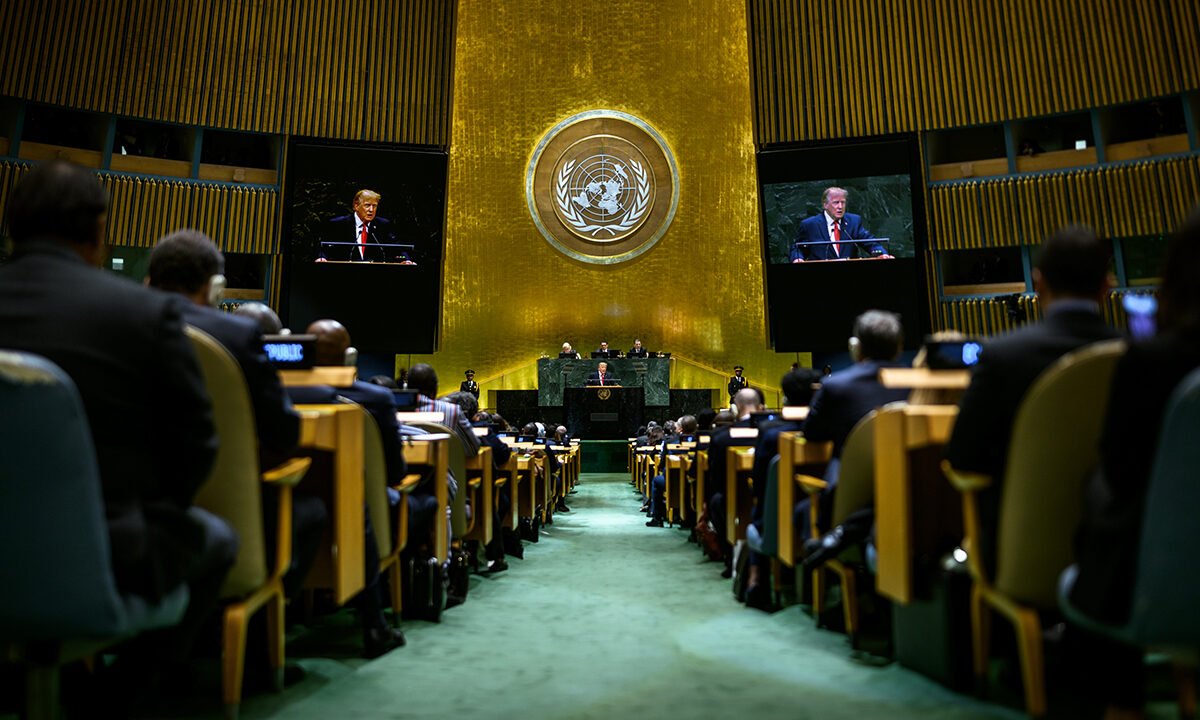
President Donald Trump used his address to the U.N. General Assembly Sept. 22 to defend the U.S.-Israeli military campaign against Iran, threaten further action if Tehran does not reach an agreement with Washington and outline an “America First” approach to artificial intelligence, migration, drug cartels and international institutions.
Speaking to the 81st session of the General Assembly in New York, Trump said the United States would act decisively against threats to its interests and criticized what he described as international efforts to impose global controls on AI or global taxes. His speech came as world leaders gathered amid conflict in the Middle East, continued concern over AI governance and wider debates over international security and migration.
Iran and military policy
Trump devoted a substantial portion of his remarks to Iran, describing the Islamic Republic as a state sponsor of terrorism and reiterating that he would not allow it to obtain a nuclear weapon.
He said he faced a choice between reaching an agreement with Iran or escalating the conflict, at one point saying the United States could “annihilate” the country if Tehran did not make a deal. He also called on other nations to support economic isolation of Iran until it stops attacks on commercial shipping, abandons nuclear ambitions and ends support for armed groups that Washington considers terrorist organizations.
Trump defended the U.S.-Israeli campaign against Iran as necessary to confront a threat he said previous governments and international institutions had not adequately addressed. Critics of the conflict have raised concerns about civilian casualties, regional escalation and the prospect that expanded military operations could further destabilize the Middle East.
Latin America and cartels
The president also said the United States would not allow threats to gain a foothold in the Western Hemisphere and would use military force when necessary to protect U.S. interests.
Trump defended his administration’s campaign against drug cartels, which he said had been designated as foreign terrorist organizations. He compared the cartels to the Islamic State group and said the United States had conducted operations against alleged drug-smuggling boats in regional waters.
He criticized the Cuban government and said his administration was seeking “fundamental change” in Cuba. Reports from the General Assembly said members of Cuba’s U.N. delegation walked out during that portion of his remarks.
AI and global governance
Trump rejected what he called a “globalist scheme” to regulate artificial intelligence, saying the United States would not support international efforts that he believed could limit its technological development.
He also proposed replacing the term “artificial intelligence” with “super intelligence,” arguing that the latter better conveys the technology’s potential. Trump said he expected AI to become more consequential than the Industrial Revolution and said the United States would encourage its growth while using domestic law enforcement measures if needed.
The remarks highlighted a central divide in global AI policy. Some governments, researchers and technology leaders have called for cross-border rules or coordinated standards to address risks related to advanced AI, including safety, misinformation, privacy, labor disruption and military applications. Trump’s position favors a more national approach and warns against international restrictions that could, in his view, slow U.S. competitiveness.
Sovereignty and institutions
Throughout the speech, Trump emphasized national sovereignty and criticized international institutions and multilateral frameworks. He said there should be “no global government” and “no global taxes” while he is president.
He also criticized the United Nations’ human rights institutions and UNESCO, arguing that they had focused criticism on U.S. policies while failing to hold authoritarian governments sufficiently accountable. The administration’s position contrasts with advocates of multilateral institutions, who argue that international bodies remain essential for addressing conflicts, climate change, public health, migration and emerging technology across national borders.
Trump framed the speech as an argument that American power and direct action (not multilateral commitments) offer the most effective response to global instability. The address reflected his broader foreign-policy approach: expanding U.S. leverage, challenging international constraints and prioritizing U.S. security and economic interests in dealings with allies and adversaries alike.