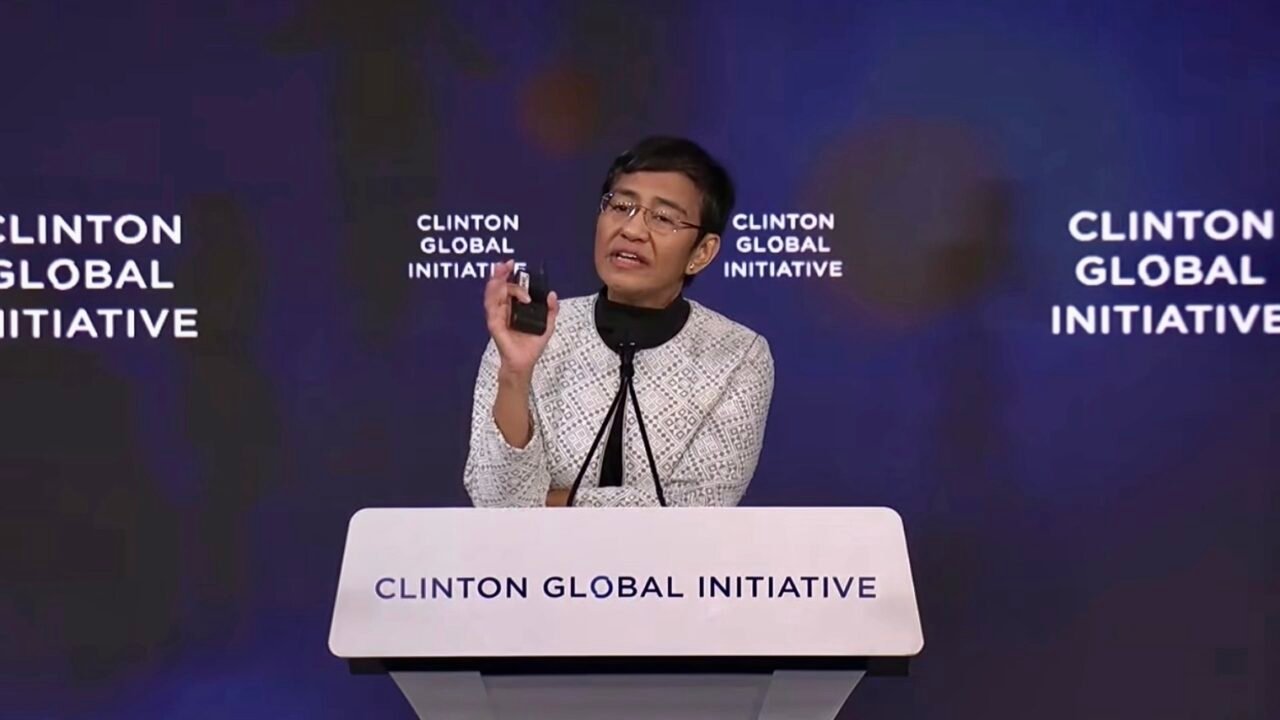
Filipino American Nobel Peace Prize laureate Maria Ressa warned global leaders Sept. 22 that artificial intelligence could weaken democracy by eroding people’s attention, trust and ability to make independent choices.
Speaking at the Clinton Global Initiative 2026 Annual Meeting, Ressa urged funders, investors and policymakers to support independent journalism and require technology companies to build safety protections into AI products before they are widely deployed.
“The fight isn’t coming. It’s here,” Ressa said during the CGI mainstage session, “Keep Going.”
Ressa, co-founder and CEO of the Philippine news organization Rappler, said the rapid rollout of social media, chatbots and autonomous AI systems has outpaced safeguards.
She described three stages of technology that she said have affected human behavior. Social media and machine-learning systems compete for attention, she said. Chatbots can exploit intimacy because they may appear to know users deeply, she said. AI agents, which can carry out tasks for users, can diminish human agency if people give them too much decision-making power, she said.
“Each of these three waves degrades our humanity a little more,” Ressa said. “A person who can’t focus, can’t trust, can’t choose — that person can’t be a citizen.”
Ressa said technology companies have released systems before they were safe because speed and profit have taken priority over safety. Those claims reflected her assessment of the industry’s incentives. Technology companies have said they are investing in safety research, testing and measures intended to reduce harmful uses of AI.
The journalist said information integrity underpins work on climate, health, poverty and other issues. Democracies, she said, depend on a shared understanding of facts.
“Without facts, you can’t have truth. Without truth, you can’t have trust,” Ressa said. “Without trust, you can’t have journalism. You don’t have a shared reality. Without that, we have no democracy.”
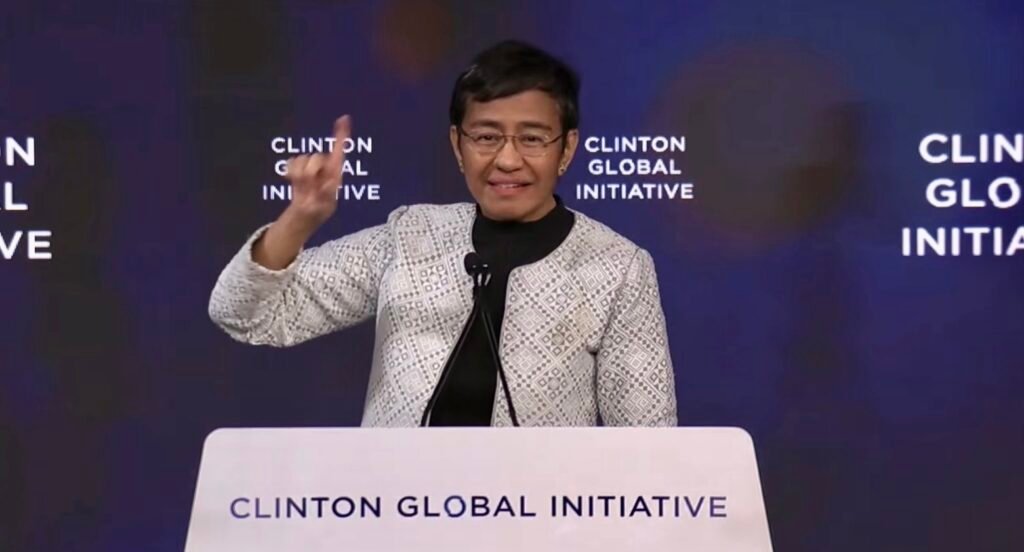
Ressa said the spread of falsehoods online, attacks on journalists and pressure on institutions can create conditions for authoritarianism. She said political leaders and powerful technology companies do not need to coordinate to benefit from that system because their interests can align.
Ressa cited the Philippines as both a warning and a source of hope. She said journalists, researchers, lawyers, churches and other groups joined in 2022 to counter false information and bring verified facts back into public debate.
She also cited the case of former Philippine President Rodrigo Duterte, who is in International Criminal Court custody on allegations of crimes against humanity connected to his anti-drug campaign. Duterte has denied wrongdoing. Ressa said Rappler’s reporting is among evidence cited in efforts to establish accountability.
Ressa called on the CGI audience to make three commitments: fund public-interest journalism, demand safety-by-design standards for AI and build coalitions across sectors.
She said independent journalism needs financial support as its business model weakens. She also said investors and funders should use their influence to press companies to establish clear boundaries for AI systems.
“Fund the facts,” Ressa said. “Fix the code. Demand safety by design. Draw red lines for AI.”
Ressa’s remarks followed recent calls for AI regulation. She currently serves as co-chair of the U.N. Independent International Scientific Panel on AI, alongside Canadian computer scientist Yoshua Bengio. The panel was established by the U.N. General Assembly to provide independent scientific assessments of AI’s effects on people and societies.
Earlier this month, Ressa told Reuters that governments should legislate limits on AI before autonomous systems further weaken human control. She said citizens should press elected officials to act, framing the issue as one of public safety rather than free speech.
The Clinton Global Initiative meeting runs through Sept. 23 in New York. This year’s gathering, organized around the theme “How Do We Get It Right?”, includes discussions on responsible AI, democracy, information integrity, climate resilience, humanitarian response, health equity and women’s equality.