Television host Boy Abunda has long been a fixture on Filipino screens and on Filipino American stages. Now, his role as patron of the arts is emerging just as prominently, through a commissioned painting series that confronts political corruption and entrenched privilege in the Philippines.
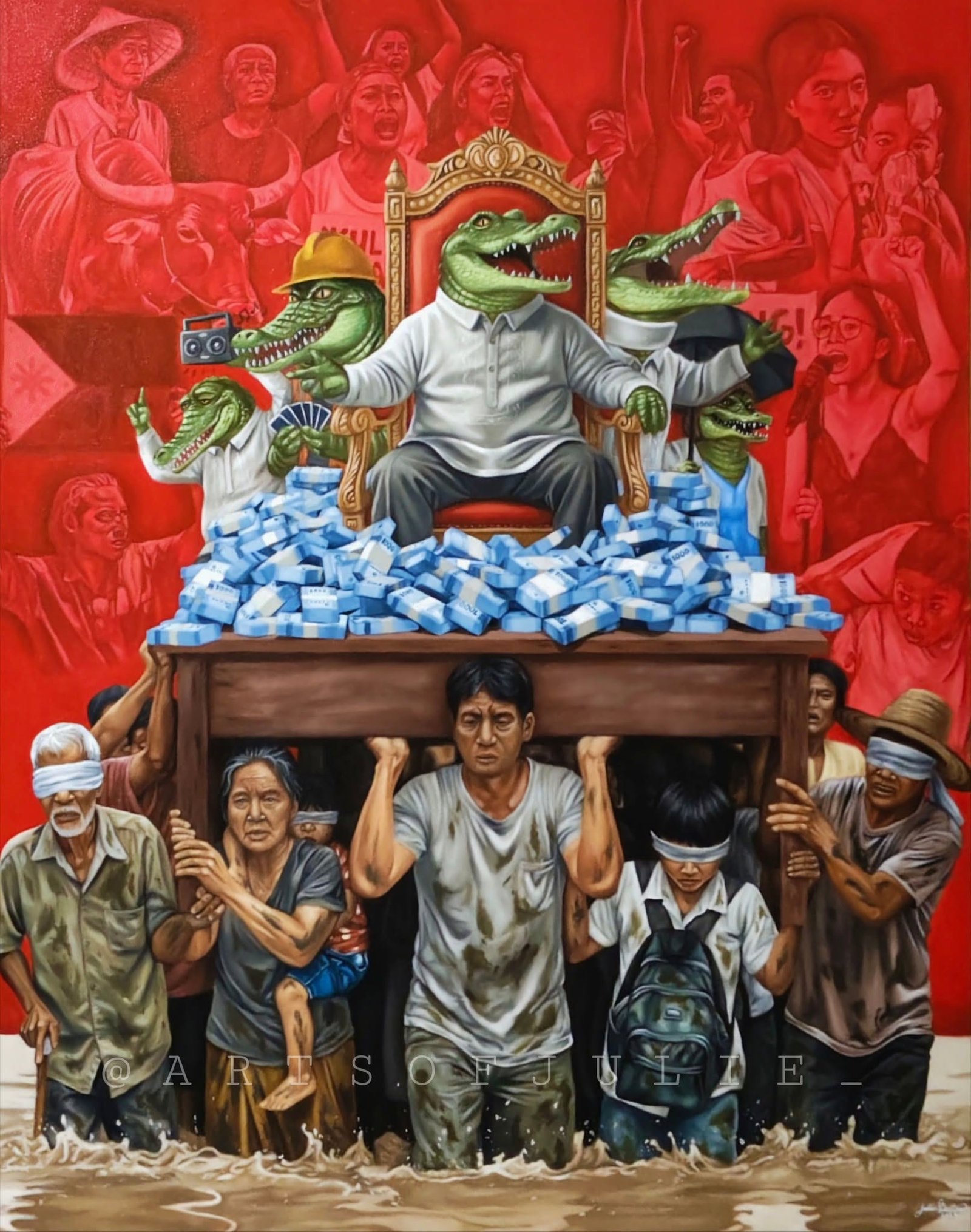
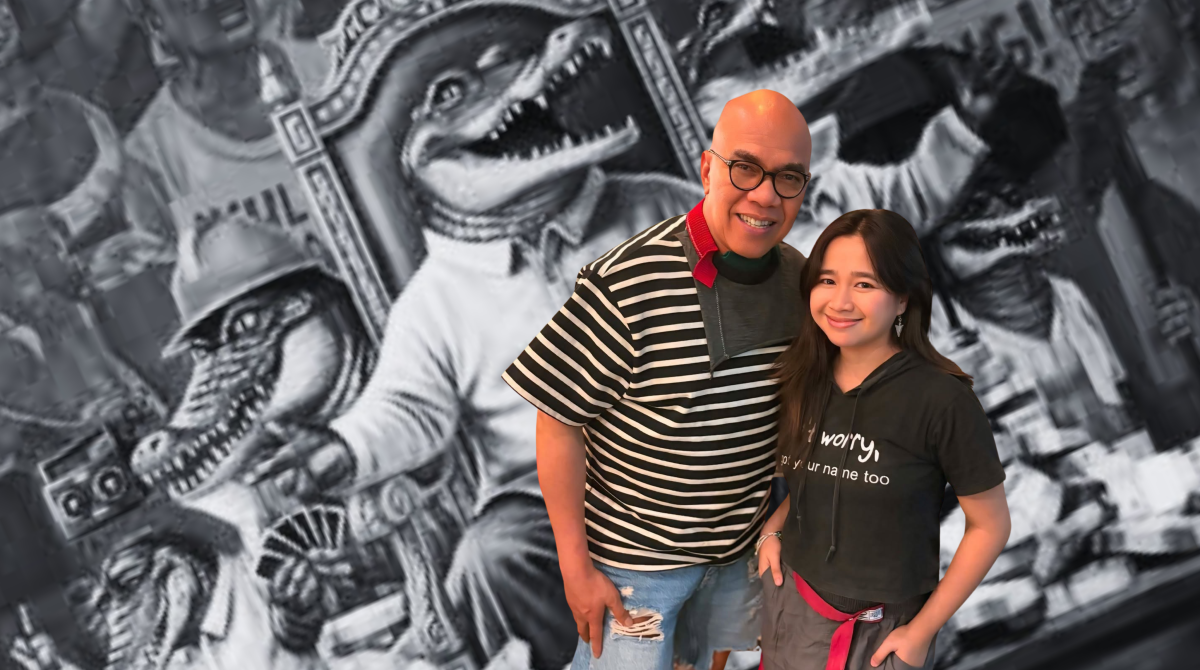
Abunda tapped visual artist and former scholar Julie Ann Baltar to create “BuwayaSerye,” a satirical collection that draws from recent controversies over flood-control projects, wealth flaunted by political families and public anger over so-called “nepo babies” and corrupt officials. The works turn public frustration into vivid tableaux of crocodiles, crumbling systems and ordinary Filipinos left vulnerable.
The series takes its title from the Filipino word “buwaya,” or crocodile, a term widely used to describe those perceived to be feeding off public funds.
Through recurring reptilian figures, submerged structures and imagery of communities exposed to literal and figurative flooding, Baltar renders themes that have dominated recent headlines: ghost projects, budget questions and the widening gulf between affluent political clans and everyday citizens.
Earlier this year, on this author’s first visit to Manila in nearly three decades, Abunda hosted a dinner in their honor at his home in Quezon City.
In between stories and laughter, he quietly introduced a set of paintings and asked that they remain under wraps until he was ready to talk about the collection publicly. At the time, he framed them as a work in progress – a visual record of a controversy still unfolding and a way to “remember what happened” long after the outrage fades.
The visit revealed what many viewers never see: off-camera, Abunda lives in a house that feels like an art museum, where nearly every wall and surface is occupied by Filipino-made pieces. Sculptures sit alongside framed photographs, paintings line hallways and even small corners are filled with work sourced from artists across the Philippines.
What stands out, friends say, is not only the volume of art but the intent behind it.
A staunch supporter of Filipino artists, Abunda has spent years building a collection largely composed of works by artisans from the provinces and Metro Manila. Some pieces carry familiar faces. He owns photographs of actor John Lloyd Cruz that he purchased without the star’s knowledge, simply because he wanted to support Cruz’s artistry and the photographers who captured him.
“BuwayaSerye” extends that support into sharper territory.
Baltar, who once relied on Abunda’s scholarship to finish her studies, now channels the host’s concerns into canvases that bear heavy symbolism. Their collaboration began with conversations and sketches, then evolved into large-format paintings that invite viewers to sit with uncomfortable questions about power, accountability and who pays the price when systems fail.
In private conversations and broadcast interviews, Abunda has framed the project as an act of documentation as much as expression, saying he wants to preserve the narratives around flood-control scandals and wealth inequality in a way that will outlast news cycles. Rather than keeping the paintings purely decorative, he has treated them as archival markers of a chapter he believes should not be forgotten.
The author, who has been friends with Abunda and his partner, Bong Quintana, for years, witnessed that impulse firsthand in Quezon City: a home curated not just for beauty but for memory, where art becomes a quiet argument for paying attention. It is a sensibility that mirrors Abunda’s on-air persona – probing, reflective and often unafraid to ask difficult questions.
That same presence will be familiar to Filipino Americans again this fall.
Abunda, who has been hosting The Outstanding Filipino Awards (TOFA) for more than a decade, since 2015, is set to return to the United States to host the 16th TOFA on Oct. 24 in Jacksonville, bringing his blend of showmanship and cultural advocacy back to the TOFA stage.