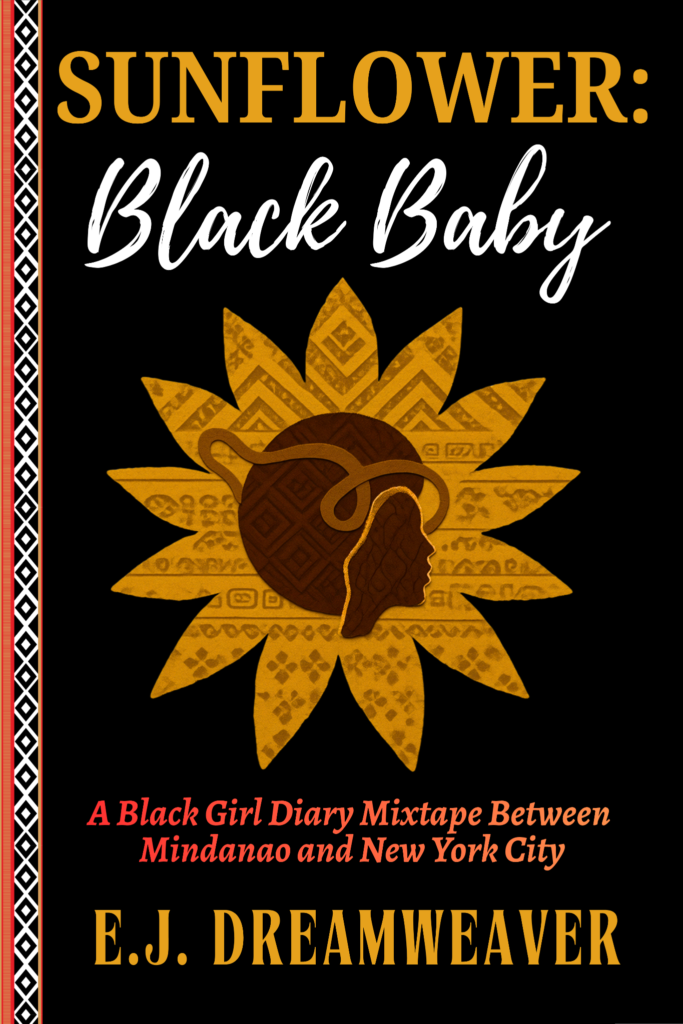
A Black Filipina girl moves between Mindanao and New York City, trying to understand the meanings other people attach to her skin, family and future in E.J. Dreamweaver’s debut novel, Sunflower: Black Baby.
The independently published book follows Mirasol, a young woman shaped by two places that see her differently. In the Philippines, where her mother is from, Mirasol’s dark skin and Black features set her apart. In New York, her Blackness carries another set of assumptions, pressures and vulnerabilities.
The novel examines how colorism, migration, class and family expectations shape a child’s sense of beauty and belonging. It also centers Mirasol’s relationship with her mother, Jojo, an overseas Filipino worker whose sacrifices create opportunities for her daughter but also leave an emotional distance between them.
Dreamweaver, the pen name of Queens-based writer Elaine Joy Edaya Degale, describes the book as “a Black girl diary mixtape between Mindanao and New York City.” The story moves nonlinearly through memory, family history, faith, friendships and desire, using song-inspired chapter titles to mirror the way people recall difficult moments: out of order, incomplete and often tied to sound.
The book’s chapters include references to songs such as “BLACK PARADE,” “PAPER PLANES,” “R.E.S.P.E.C.T.,” “DANDANSOY,” “BAD ROMANCE” and “ROYALS.” The music is intended to work as more than a playlist, adding another emotional and cultural layer for readers who recognize the songs and their associations.
“Filipinos often learn not to talk about pain, but to laugh through it,” Dreamweaver said. “‘Tawanan mo lang ang problema,’ or, roughly, ‘Learn to laugh at your problems.’”
For Dreamweaver, humor and music offer a way to write about difficult subjects without flattening the characters into symbols of trauma. She cites W.E.B. Du Bois, Toni Morrison and Filipino novelist F. Sionil José among the writers and thinkers who influenced her approach to music, race, class and storytelling.
At its center, Sunflower: Black Baby asks whether material provision can fill the emotional gaps created by migration. Jojo’s life has been shaped by poverty, work and the promise of the American Dream. She measures love through sacrifice and responsibility; Mirasol wonders whether being cared for financially is the same as being fully seen.
The tension is especially sharp within an extended family divided by geography and unequal resources. Because Mirasol is American, she is often presumed to have more than her relatives in the Philippines, even when she feels that what is meant for her is being redirected elsewhere.
The book is the first installment in Dreamweaver’s planned Flower Novels Universe, an interconnected literary project using flowers as symbols in stories about identity, feminism, migration, faith, grief, resilience and love.
Dreamweaver began developing the project through National Novel Writing Month, or NaNoWriMo, the annual challenge in which participants aim to write 50,000 words during November.
Her writing has appeared in several literary anthologies, including Black Butterfly: Voices of the African Diaspora in 2025, which published an excerpt from Sunflower: Black Baby. Other excerpts from works in progress have appeared in Native Voices II: The Cry of Creation and Iridescence: Second Dimension, according to the author’s biography.
Sunflower: Black Baby, the first book in Dreamweaver’s planned Flower Novels Universe, is now available through Amazon.