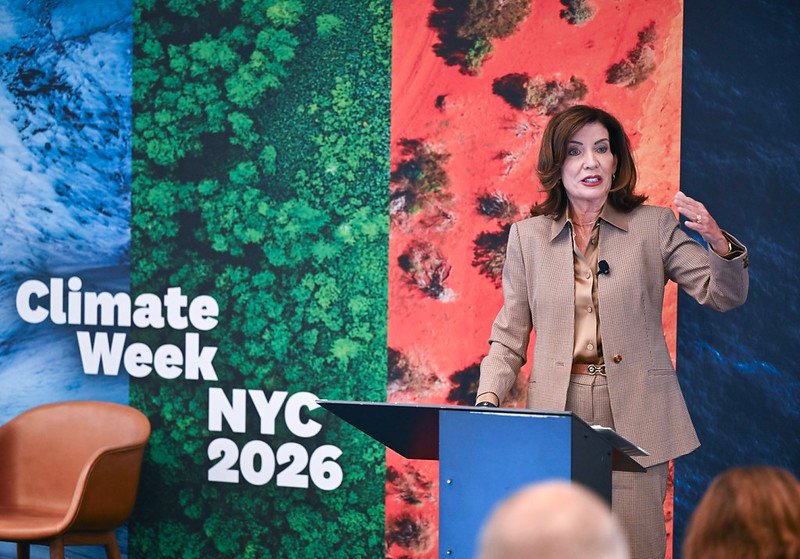
Gov. Kathy Hochul urged investors Sept. 23 to support New York’s clean-energy buildout, arguing that the state must expand renewable and nuclear power while protecting residents from the rising costs and energy demands associated with data centers and artificial intelligence.
Speaking at a Ceres Climate Week event in New York City, Hochul said New York is pursuing 95 large-scale solar, wind, hydroelectric and offshore wind projects expected to deliver 10.5 gigawatts of clean power, enough to serve more than 4.6 million homes, according to her office.
“I want clean, affordable power for families, but I’m not going to have an economy that’s stuck in the past,” Hochul said.
The governor said New York faces two connected challenges: accelerating climate change and increasing electricity demand. She pointed to severe winter storms, extreme weather and the growing energy needs of major industrial projects and data centers.
Hochul said the state is moving forward with renewable generation, transmission projects and an expansion of nuclear power. She also called on private investors to provide capital for the transition.
“It would be smart money to invest, for sure, in a place like New York,” Hochul said. “I’ll break down any barrier that stands in our way of doing what I need to do to support my economy, to keep the lights on, to drive down costs for consumers and create thousands of good-paying clean-energy jobs.”
Hochul criticized federal policies under President Donald Trump, saying they have made it harder for New York to meet its climate and energy goals. She cited the administration’s approach to offshore wind and said the federal government had halted or delayed opportunities for future lease areas.
She pointed to Empire Wind, a long-planned offshore wind project intended to provide electricity for about 500,000 homes in Brooklyn. Hochul said the project faced uncertainty after federal action halted it and that state officials worked to keep the developer from abandoning it.
The Trump administration has argued that offshore wind projects can pose environmental, cost and reliability concerns. Supporters of the industry say offshore wind is needed to diversify power supplies, reduce emissions and create construction and manufacturing jobs.
Hochul also highlighted the Champlain Hudson Power Express, a transmission project designed to carry hydropower from Quebec to New York City. She said the project demonstrates how public and private investment can add cleaner electricity to the state’s grid.
The governor said New York plans to build more nuclear power, describing the technology as part of a broader strategy to provide reliable electricity without carbon emissions. Nuclear projects require federal licensing and can take years to develop, and critics have raised concerns about cost, waste disposal and construction timelines. Supporters say nuclear generation can provide stable, emissions-free power when wind and solar production varies.
Hochul said New York has imposed a one-year moratorium on new data centers while it develops statewide rules for facilities with large energy demands. Her office did not immediately provide details on the scope or legal basis of the moratorium.
The governor said she wants data-center developers to supply their own power or contribute significantly to grid upgrades, community benefits and local utility costs. She said the state would help local governments negotiate with large technology companies.
Hochul cited proposals for five data centers in St. Lawrence County, saying that if all were approved, they could consume as much electricity as a new nuclear reactor would produce. The governor said she wants data-center development to deliver clear benefits to host communities and avoid shifting costs to other utility customers.
“I understand the need to power AI,” Hochul said. “But when you’re looking to come and consume massive amounts of land and energy, the communities have to come out ahead of that.”
Her remarks came during Climate Week NYC, an annual gathering of business, government, nonprofit and climate leaders held alongside the United Nations General Assembly.